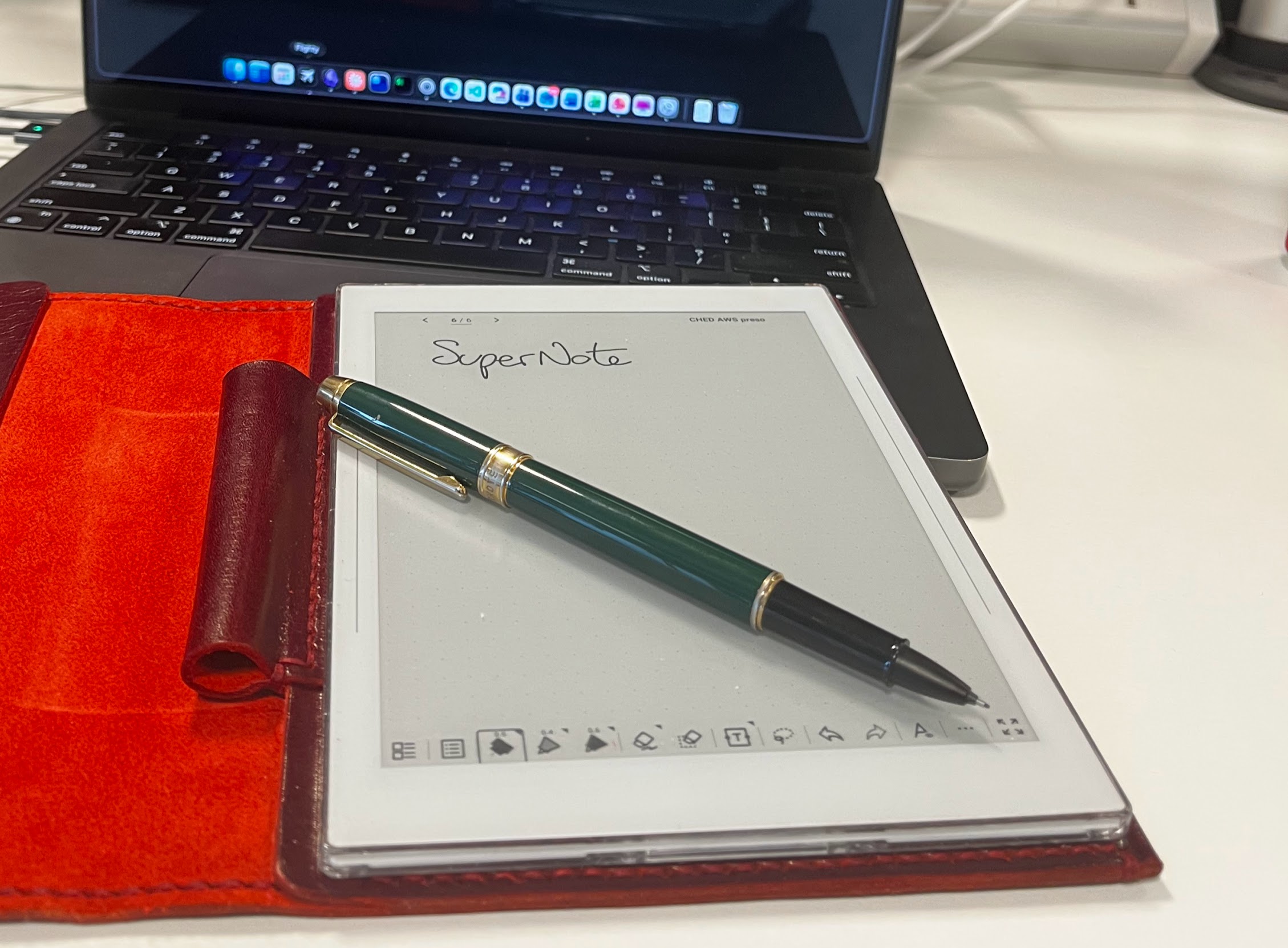
Built in the Gaps: The Remarkable experiment — handwriting my way back to thinking
For most of my working life I didn’t know what I didn’t know about how my brain works.
I took notes. Sometimes on paper, sometimes digitally. I tried different apps, different systems, different notebooks. They were OK. The notes existed, and then, reliably, the thing I’d written down would disappear into wherever notes go when life moves on — buried under the next meeting, the next thought, the next thing my brain decided was more urgent.
I didn’t see it as a failing. It was just what it was. My brain works in bursts — intense focus, then on to the next thing. I accepted that. What I sat underneath it was that quiet, persistent anxiety that something had slipped. That I’d forgotten something that mattered to someone.
It took me longer than it should have to realise the issue wasn’t the notes. It was what happened — or didn’t happen — after I wrote them.
When the Remarkable Paper Pro and SuperNote Manta came out I bought one of each. Not because I had a plan — because they grabbed me; as many tech toys do. Small, portable, does one job excellently.
By the way, the e-ink experience has matured to the point where writing on it genuinely feels close to paper in a way earlier versions didn’t. I still use a fountain pen and a physical notebook sometimes, and I don’t think I’ll ever fully give that up. But the Remarkable and/or SuperNote go everywhere with me, and that mattered.
So when rotate to a Supernote Manta or back to remarkable, its a different device, same workflow, same result.
What happens after I put the pen down?
If the device I am using is connected to wifi, it syncs my notes to the cloud. Every thirty minutes, a set of scripts running on my home server pulls those notes down, converts the handwritten pages into readable text, and drops them into a folder in my vault as a markdown file. My “chicken scratchings” — legible only to me, full of half-sentences and circled words and underlined actions — become structured text that the rest of the system can work with.
To explain it the way I’d explain it to my wife in the kitchen: I write something down in a meeting, walk out, and by the time I’ve made a coffee the note is sitting in my system — not just as text, but as a set of actions ready to be reviewed, surfaced on my NexBoard dashboard.
The handwritten page gets converted into a markdown file with two things in it: a visual (jpg) of the original note exactly as I wrote it, and a readable text extraction. That file goes to a local AI model running on my home server. The model reads the text and infers what I meant to do — the actions, the commitments, what needs to happen next. Those surface on NexBoard as open items, ready for me to confirm, schedule, or dismiss.
I didn’t type anything up. I didn’t transfer anything. I just wrote, in my own hand, in my own shorthand, and the system did the rest.
It would have been easier to build this around typed notes. I didn’t, because handwriting is coded to you.
My scratchings are in my code — nobody else would get them, and they don’t need to. The shorthand, the circled words, the underlined actions, the way I compress a sentence into four words that only make sense in context — that’s not a bug in my note-taking. It’s how I actually think. Forcing it into a typed format would slow it down, formalise it, make it something it isn’t.
The system doesn’t ask me to change how I write. It reads what I meant and acts on it.
When it works the feeling is straightforward: relief that something didn’t get lost, satisfaction when the loop closes, and a quiet pride in the fact that I understood my own brain well enough to build something that fits it.
I can sit in a meeting and be present. Write my notes my way. Know that the system will close the loop — for my family, a colleague, a client. That used to be the anxiety. Now it’s just how it works.
AI at an individual level is still being figured out — by people like me, in spare time, on home servers, in the gaps between everything else. And it doesn’t require a team, a budget, or a technical background. It requires curiosity and a bit of initiative.
What I built is bespoke to me. My brain, my shorthand, my workflow. It talks to me through Telegram, surfaces on a dashboard I built, runs quietly on a machine in my home office. It’s as subtle or as visible as I want it to be.
Yours would look completely different. An iPhone app. A browser extension. A daily digest in your inbox. The shape doesn’t matter — what matters is that it fits how you actually think and work, not how a product manager imagined you might.
That’s what I’d encourage. Not to build what I built. But to genuinely explore what this technology could do for you — the specific, personal, only-makes-sense-to-you version of it. Because that version exists. You just haven’t built it yet.
Comments