I probably have ADHD. I built an AI operating system to work with that, not against it.
I probably have ADHD. I’ve never had it formally diagnosed, but the pattern is familiar enough that the label doesn’t really matter. What matters is that my brain captures things in fragments — a thought in a meeting, a code snippet at midnight, a task buried in a chat thread — and without a system to catch them, they’re gone. Not forgotten exactly. Just… unreliable.
The cost of that isn’t dramatic. It’s not one catastrophic failure. It’s the slow drip of being asked “did you do that?” and not being certain. It’s the pressure of owing someone something you can’t immediately locate. It’s the mental overhead of managing your own uncertainty about what you’ve committed to and what you’ve dropped.
I built Doug to fix that.
I’ve never been formally diagnosed with ADHD. But I know my brain well enough to know something is different about how it handles information. Thoughts arrive fast and leave faster. Commitments made in conversation feel solid in the moment and fuzzy an hour later. The question “have you done that?” lands differently on me than it probably does on most people — not as a simple check-in, but as a small spike of anxiety, because the honest answer is often “I think so.”
That’s not laziness. It’s not disorganisation in the way people usually mean it. It’s that the filing system most people seem to have built into their heads — the one that quietly tracks open loops and surfaces them at the right moment — mine doesn’t work that way. Things fall through. Not dramatically. Just quietly, consistently, enough to build a background pressure that never fully goes away.
The cost is hard to point to specifically. It’s not one missed deadline or one dropped ball. It’s the accumulated weight of not fully trusting yourself. Of managing your own uncertainty as a second job running underneath the actual work.
I needed a system that could hold what my brain drops. Not remind me of everything — that’s just noise. Something that watches the surfaces where I actually think and work, catches what matters, and puts it somewhere I’ll see it when I need to.
That’s what I built Doug to do.
Doug is the engine. It runs on a Linux box in my home office — nothing exotic, just a machine that’s always on, always listening, always inferring. The agents that run on top of it — Nigel, Di, Craig, Saeed — are the actors. They don’t make decisions. They surface the right information at the right moment so I can.
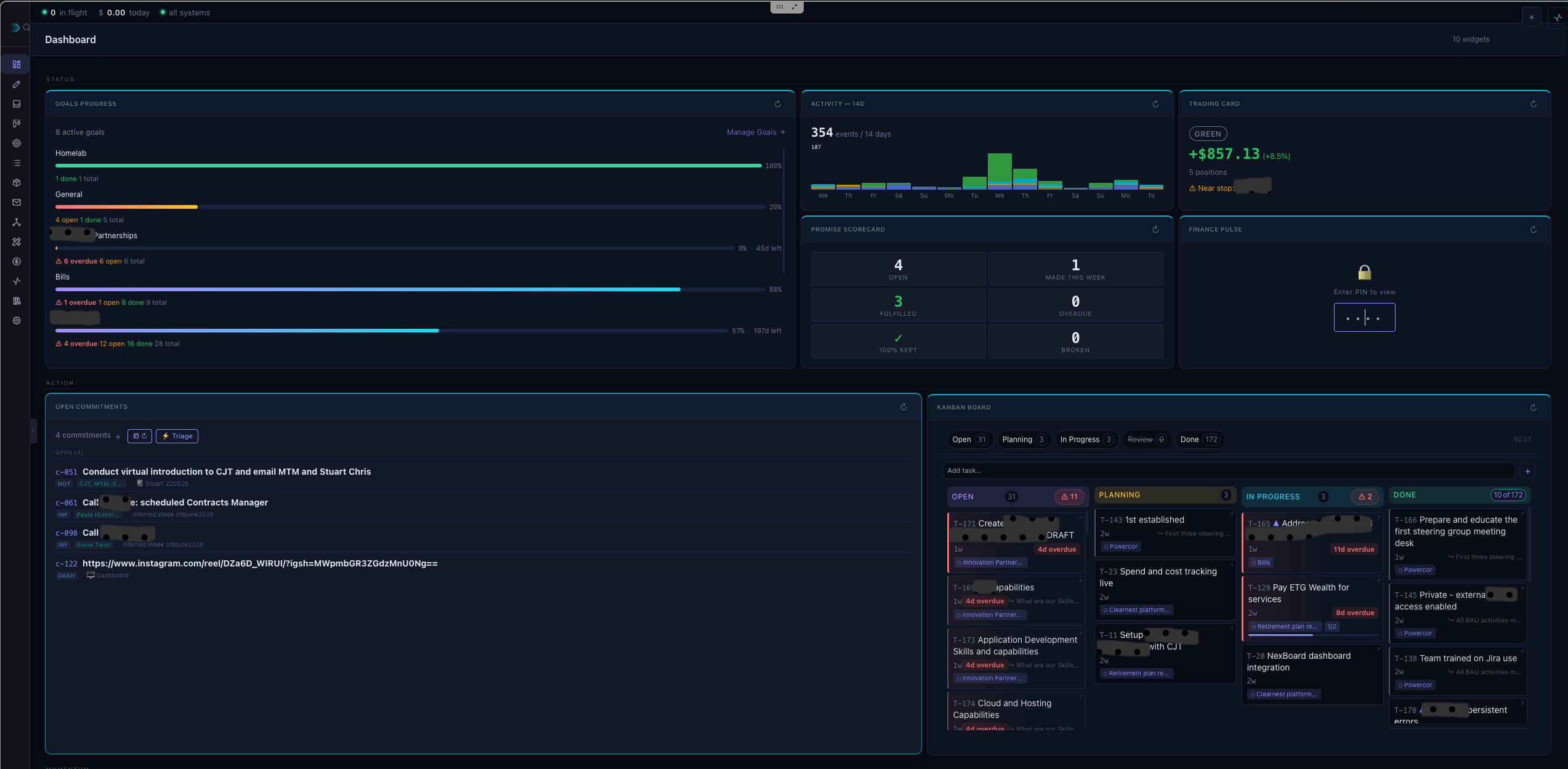
Everything flows into NexBoard, a dashboard I built that functions as my “what next” interface. Not a to-do list. Not a calendar. Something closer to a live picture of where my attention should go.
The intake points are everywhere. I write by hand on a Remarkable — those notes sync to my vault and every thirty minutes a routine reads them, infers anything that looks like a commitment or an action, and surfaces it on NexBoard as an open item. I can convert it to a task, a goal, a calendar appointment, or dismiss it. Nothing gets lost in a notebook.
Chat with Nigel works the same way. If I mention something I need to do, it gets captured. Coding sessions create backlog items directly. And sometimes I just drop a link — an article, a price, a signal — as a raw commitment to look at later.
This conversation started that way. I was reading in bed last night, found an article that sparked something, captured the link as a commitment, and actioned it this morning.
That’s the system working. Not AI replacing thinking — AI making sure the thinking I’ve already done doesn’t disappear.
The agents have names because they have roles, and roles felt more honest than calling them Bot-1 through Bot-5.
Nigel is my chief of staff. He runs the morning brief, tracks my commitments, watches my calendar, and is usually the first thing I interact with each day. If something needs my attention, Nigel surfaces it. If I mention something in passing that sounds like a commitment, Nigel catches it.
Di handles email. Not all of it — I still read, I still decide — but Di triages, flags what matters, and keeps the inbox from becoming a place where things go to disappear.
Craig watches money. Expenses, portfolio movements, signals worth paying attention to. When the petrol price dropped recently and my trading data showed an overnight return spike of six to eight percent, that connection didn’t require me to be watching two screens at once. Craig and Nigel between them put it in front of me.
Saeed covers engineering — backlog, build priorities, technical decisions that need context I’d otherwise have to reconstruct from scratch.
None of them act autonomously in any meaningful sense. They don’t send emails without me, don’t make trades, don’t book meetings. What they do is make sure that when I sit down to decide something, I’m deciding with the full picture rather than whatever fragment of it I happened to remember.
The names aren’t arbitrary. Each one belongs to someone I knew, worked with, respected or admired. That felt right. If these agents were going to hold the things I trust, they should carry names that mean something.
I’m not writing this as a blueprint. The specific stack I built — Python, PostgreSQL, Docker, a Linux box called Doug — isn’t the point. Most people won’t build this and shouldn’t have to.
The point is the underlying idea: that the surfaces where you actually think and work can be connected, and that connection can hold what your brain drops.
Most productivity systems ask you to change your behaviour to fit the system. Capture things here, in this format, at this time. That works for some people. It never worked for me. What I needed was something that met me where I already was — in a chat, in a handwritten note, in a coding session at midnight — and did the inferring for me.
That’s what AI makes newly possible. Not replacing thinking. Not automating decisions. Just closing the gap between a thought and an action, reliably, across every surface where thinking actually happens.
If you have a brain that works the way mine does — fast intake, unreliable filing, high sensitivity to dropped commitments — that gap is the whole problem. Close it and the pressure doesn’t disappear, but it changes character. It becomes priority instead. What do I do next, rather than what have I forgotten.
That’s a different way to live. It took me longer than it should have to build it. I don’t think it needs to take anyone else that long.
Here’s what the system doesn’t do.
It doesn’t fix anything.
There was a personal tragedy that preceded all of this. Something that made me stop and reckon with what actually mattered — purpose, priority, the noise I’d been carrying and the things I’d been ignoring. I’m not going to detail it here. But it’s the real reason this build started.
Doug and NexBoard and the agents — they were a positive distraction at a moment when I needed one badly. Something to pour my mind into. Something that scratched the curiosity itch I’ve always had about technology without requiring me to perform or produce for anyone else. I built it in spare time. Nights. Early mornings. Gaps in the calendar. And it kept me sane during a period when sanity wasn’t guaranteed.
But I want to be honest about what it is and isn’t.
The system surfaces things. It doesn’t make me act on them. There are still mornings where the dashboard is full and I ignore it — ADHD doesn’t vanish because you built something clever to manage it. The insights are there. The actions are there. And sometimes I still scroll past them.
It also doesn’t replace people. It doesn’t replace conversation, presence, the specific value of someone sitting across from you who actually knows you. The agents have names I love but they’re not the people those names belong to. That distinction matters.
What it does — genuinely, palpably — is lift a particular kind of pressure. The pressure of not knowing. Of dropped commitments and fuzzy memory and the low hum of self-doubt that comes with both. That pressure is gone, or close enough to gone that the difference is real.
What’s left is priority. What do I do next. That’s not nothing. For a brain like mine, that’s enormous.
This conversation — the one that became this article — started with a link I captured in bed last night.
I was reading, something sparked, I dropped the link into NexBoard as a commitment. This morning it was sitting there. I actioned it. A few hours later, here we are.
That’s not a miracle. It’s not artificial intelligence solving humanity’s problems. It’s just a thought that didn’t get lost.
For most of my life, that was the exception. Now it’s the default.
I don’t know if what I’ve built is something others could use, or should use, or would even want. The stack is specific, the setup is involved, and the honest answer is that it took a significant personal crisis to give me the motivation to start. I wouldn’t wish that on anyone.
But I do think the underlying hunger is common. The feeling of having more going on than your brain can reliably track. The tax of managing your own uncertainty. The quiet exhaustion of never quite trusting that you’ve got it all covered.
If that sounds familiar — this is just one person’s answer to it. Built in the dark, in the gaps, for reasons that started with grief and ended somewhere close to peace.
Doug’s still running. Nigel’s already drafted tomorrow’s brief. And I finally know what I’m doing next.
Comments