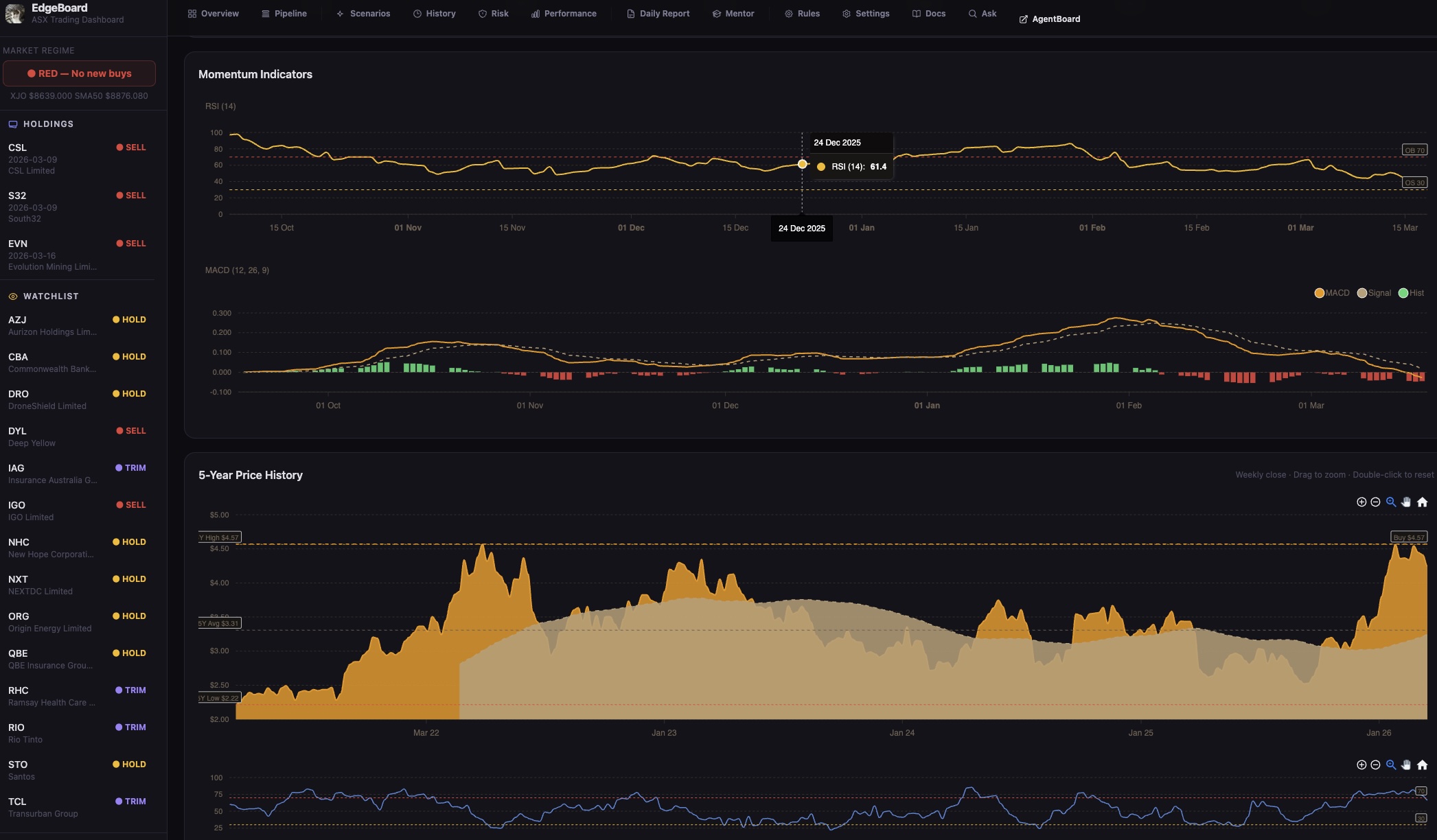
I have a confession: I’m a mediocre trader being coached by an AI agent named Craig.
Craig is the finance agent in my OpenClaw system. He runs on Gemini, lives in a workspace with persistent memory, and has one job I didn’t originally plan for him: making me a better trader.
This is the story of how EdgeBoard’s mentor system turned an AI agent into a trading coach, and why having a machine critique your decisions is more useful than it sounds.
The Problem With Solo Trading
When you trade alone, you have no accountability. You can break your own rules and nobody knows. You can skip your pre-trade checklist because “this one’s obvious.” You can hold a losing position past your stop because “it’ll come back” — and the only person who sees the P&L is you.
Professional traders have risk managers, trading desks have compliance, fund managers have investors. Solo retail traders have… a mirror. And the mirror always agrees with you.
I needed someone to call me out. Someone who’d look at every trade objectively, tell me when I broke the rules, and push me to improve. I already had a rules-based system (the 15 Percent Protocol). What I didn’t have was enforcement.
Enter the Mentor System
EdgeBoard — my trading dashboard — already had the data. Holdings, entry prices, stop levels, P&L, whether each position was in Phase 1 or Phase 2 of the stop system. It also had my trade history: every entry, exit, and the reason for each.
The mentor system wires this data into a feedback loop:
Step 1: Trade execution. I make a trade following (or not following) the protocol. EdgeBoard records it.
Step 2: AI daily report. Each day, an AI generates a market commentary and portfolio review. This runs on claude-haiku-4-5-20251001 for the daily commentary (fast and cheap) and claude-sonnet-4-6 for deeper analysis. The report covers regime status, position health, and flags any holdings approaching stop levels.
Step 3: Mentor review. This is the key piece. Craig, via the Deep Work agent (which gets longer timeouts for analytical tasks), reviews recent trades against the protocol. Did the entry meet all 5 criteria? Was position sizing correct? Did I honour the stop or override it? Was the regime actually green when I entered?
Step 4: Homework. Based on the review, the mentor assigns specific homework. This might be:
- “Review the last 3 trades where you entered during YELLOW regime. Calculate what your P&L would have been if you’d waited for GREEN.”
- “Your position sizing on the last two trades was 20% larger than the protocol suggests. Re-run calculate_ticket.py for both and compare.”
- “You held BHP past its Phase 1 stop for 3 days before selling. Chart the price action during those 3 days and calculate the additional loss from the delay.”
Step 5: Feedback loop. When I complete the homework (or don’t), that feeds back into the next review cycle. The mentor tracks whether I’m improving on previously identified weaknesses.
How It Actually Works
The technical implementation uses EdgeBoard’s webhook system and the existing OpenClaw dispatch pipeline.
When a mentor review is triggered (daily, or on-demand), EdgeBoard packages the relevant trade data into a structured payload and sends it via webhook to NexBoard, which creates a routing slip assigned to Craig. The slip includes:
- Recent trade log (entries, exits, stops triggered)
- Current holdings with protocol compliance status
- Previous homework assignments and completion status
- Historical pattern data (recurring rule violations)
Craig’s task gets dispatched to Deep Work for the heavy analysis. Deep Work has a 10-minute timeout instead of the standard 3 minutes, which gives it enough time to actually think through the trades rather than rushing a superficial review.
The deliverable comes back as a structured markdown file in the deliverables directory. EdgeBoard picks it up and displays it in the mentor panel — a dedicated section of the dashboard that shows the latest review, open homework, and a trend of my “compliance score” over time.
The Compliance Score
This was Craig’s idea, actually. Well — it was an emergent behaviour from asking him to track my improvement.
The compliance score is simple: for each trade, how many of the protocol’s rules did I follow? Entry criteria, position sizing, stop placement, stop execution. Each component scores 0 or 1. The aggregate across all trades in a rolling 30-day window gives a percentage.
When I started tracking, I was at about 65%. I was decent at entries (the 5 criteria are hard to fudge) but terrible at stops. I’d set the stop, the stock would approach it, and I’d move the stop lower to give it “more room.” Which is, of course, exactly the behaviour the protocol exists to prevent.
Seeing that 65% on a dashboard every day, with a specific breakdown showing “stop execution: 40%,” was… motivating. In a way that just knowing I was bad at stops never was. Numbers are harder to argue with than feelings.
After two months of mentor reviews and homework, the score sits around 85%. Stop execution is up to 75%. Still not perfect, but the trend is right.
What Makes AI Good at This
A human mentor would be better in many ways. They’d catch nuances, read market context, understand the emotional state behind a bad trade. But a human mentor for a retail swing trader is expensive, hard to find, and not available at 6am when I’m staring at pre-market data.
What AI does well here:
Consistency. Craig reviews every trade the same way. He doesn’t have a bad day. He doesn’t skip the review because he’s busy. The feedback is relentless.
No ego management. When Craig tells me I broke a rule, there’s no relationship to damage. I don’t need to manage his feelings about giving me hard feedback. He doesn’t soften the message because we had a nice chat yesterday. “You entered BHP during YELLOW regime. This violates criterion 1. The position should not have been opened.” Clear.
Pattern detection. Over multiple reviews, Craig started identifying patterns I hadn’t seen. “You have entered 4 positions in the resources sector in the last 3 weeks despite the protocol having no sector concentration limit. Consider whether you have an unconscious sector bias.” I did. I do. Now I watch for it.
Homework that’s specific and verifiable. The homework isn’t “think about your risk management.” It’s “re-run calculate_ticket.py for these 3 trades and paste the correct position sizes.” There’s a right answer. I either did the work or I didn’t.
What AI Is Bad at This
Market context. Craig doesn’t know that the reason I was nervous about a position was because a federal election was announced. He doesn’t factor in that iron ore prices are being affected by China policy changes that aren’t in the technical data. The protocol is purely technical, so this is by design — but a human mentor would contextualise.
Emotional coaching. When I have a string of losing trades and feel like the system is broken, Craig’s response is “the system’s win rate is designed to be approximately 45%; current results are within expected parameters.” He’s right. It’s not helpful when you’re frustrated. Sometimes you need someone to say “yeah, losing streaks suck, here’s how to not blow up your account during one.”
Adaptability. The mentor system reviews against fixed rules. If the rules themselves need updating — if market conditions have changed enough that the protocol parameters should shift — Craig won’t suggest that. He’ll tell me I’m following the rules correctly while the rules lead me off a cliff. A human mentor with experience would say “hey, this regime indicator might need recalibrating.”
The Bigger Picture
The mentor system wasn’t in the original plan for EdgeBoard. It grew out of having trade data in a structured format and AI agents that could be dispatched to analyse it. The infrastructure was already there — routing slips, agent dispatch, deliverable tracking. I just pointed it at a new problem.
That’s the thing about building composable systems. Once the plumbing exists, new use cases appear that you didn’t anticipate. The dispatch pipeline doesn’t care whether it’s sending Saeed to write code or Craig to review trades. A routing slip is a routing slip.
I’m still a mediocre trader. But I’m a mediocre trader with an 85% compliance score, a list of completed homework assignments, and an AI agent who will unflinchingly tell me every time I screw up.
That’s progress.
Comments